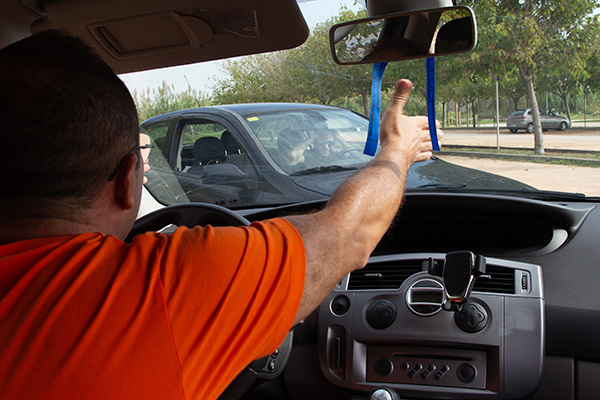
A reckless driver can turn an ordinary trip into a stressful situation within seconds. They may follow too closely, cut across lanes, speed around traffic, brake aggressively, or attempt to provoke a reaction. Your safest response is to reduce contact, create distance, and avoid allowing their behavior to control your decisions.
Staying calm does not mean ignoring a real threat. It means keeping enough control to protect your passengers, choose a safe route, and recognize when emergency assistance is necessary. The goal is not to correct the other driver. The goal is to leave the situation without a collision or confrontation.
Recognize The Stress Response Early
Aggressive driving can trigger an immediate physical reaction. Your heart rate rises, your grip tightens, and your attention narrows toward the other vehicle. That response can make drivers accelerate, follow, gesture, or change lanes without carefully checking their surroundings.
Notice the reaction before acting on it. Loosen your grip on the steering wheel, take one slow breath, and look farther down the road. Expanding your visual attention helps you track traffic signals, pedestrians, intersections, and escape routes instead of focusing entirely on the aggressive driver.
Create More Space As Soon As Possible
Distance gives you time to react. If another driver is following too closely, avoid sudden braking or sharp lane changes. Signal clearly, move into another lane when it is safe, or reduce speed gradually so the driver can pass.
If the reckless vehicle is ahead of you, increase your following distance. Do not try to keep pace or pass simply to get away faster. A driver who is weaving through traffic may change lanes again without warning. Additional space lowers the chance that their next move will involve your vehicle.
Never Try To Teach The Other Driver A Lesson
Blocking a passing lane, tapping the brakes, accelerating to prevent someone from merging, or following them after an incident can escalate the situation. Even when the other driver clearly caused the problem, responding aggressively increases the risk for everyone nearby.
Avoid eye contact, gestures, shouting, and repeated horn use. Use the horn briefly when needed to warn of an immediate collision risk. Once the danger has passed, continuing to use it can be interpreted as a challenge.
You do not know whether the other driver is distracted, impaired, emotionally unstable, or carrying a weapon. Their behavior has already shown poor judgment. Do not give them another reason to focus on you.
Keep Your Driving Predictable
Use turn signals, hold a steady lane position, and avoid unnecessary speed changes. Predictable movement helps surrounding drivers understand what you intend to do and reduces the chance of another conflict developing.
Before changing lanes, check mirrors and blind spots carefully. Stress can cause drivers to concentrate on one vehicle and overlook a motorcycle, cyclist, pedestrian, or car approaching from another direction.
If traffic is dense, remain patient until a safe opening appears. Driving onto the shoulder, crossing multiple lanes, or making an illegal turn may create a greater danger than the reckless driver. Choose the safest legal way to separate from the situation.
Do Not Lead Them To Your Home
If another driver appears to be following you, do not drive home, to work, or to another location where people you know may be present. Keep the doors locked, windows closed, and remain inside the vehicle.
Drive toward a police station, fire station, or busy public location with good lighting and security cameras. Call emergency services using hands-free controls or ask a passenger to make the call. Provide your location, direction of travel, vehicle description, and license plate number when it can be read safely.
Do not stop on a quiet road to confront the driver. If they leave their vehicle and approach yours, keep the doors locked and leave the area when you have a safe path. Use the horn to attract attention if you are blocked and feel threatened.
Know When To Report Dangerous Driving
Call emergency services when a driver is creating an immediate danger. Examples include driving into oncoming traffic, repeatedly forcing vehicles off the road, appearing severely impaired, intentionally striking another vehicle, or following someone while making threats.
Useful information includes:
- Vehicle color, make, and model
- License plate number
- Current road and direction of travel
- Nearest intersection or landmark
- Specific dangerous actions
- Number of occupants when visible
Do not speed, follow closely, or hold a phone to record the vehicle. A passenger can write down details or make the call. Your responsibility is to report what you observed while maintaining safe control of your own car.
Take A Break Before Continuing
After the other driver is gone, your stress response may remain elevated. Pull into a safe parking area when possible and take several minutes before continuing. Check that everyone in the vehicle is okay and review whether the car was struck or forced over debris.
If contact occurred, inspect the tires, wheels, lights, mirrors, and body before driving farther. New steering pull, vibration, warning lights, fluid leakage, or tire damage requires an inspection. Do not continue at highway speed when the vehicle no longer feels stable.
Regular maintenance also supports confident emergency responses. Proper tire pressure, dependable brakes, working lights, clear mirrors, and responsive steering help the vehicle react correctly when you need to slow down or change direction.
Get Vehicle Safety Service In Silver Spring, MD, With Allen Automotive
Allen Automotive in Silver Spring, MD, can check your brakes, tires, steering, suspension, lights, mirrors, and alignment after a close call or road incident.
Contact us to schedule service if your vehicle was struck, forced over debris, or began driving differently after an encounter with a reckless driver.